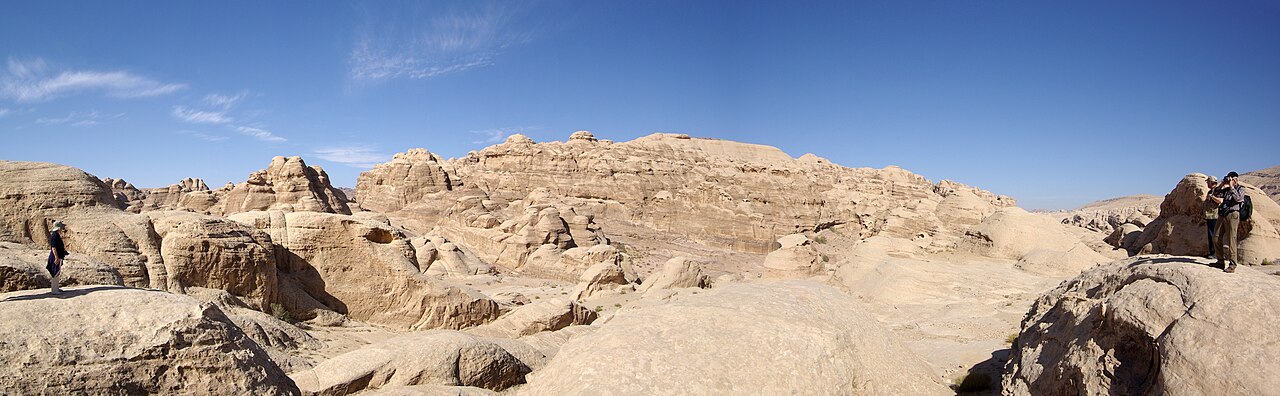
The Nabataean merchants who built Petra were masters of a world most Romans never saw. From roughly the 4th century BCE, these Arab traders controlled the frankincense and myrrh routes linking the Arabian Peninsula with the Levant and the Mediterranean. Their caravans moved spice, silk, and precious resin across deserts that defeated armies, and the staggering profits from this trade funded something the ancient world had rarely attempted: a city carved, not constructed, from the living rock of rose-red sandstone cliffs in what is now southern Jordan. Petra was not merely a settlement but a statement of dominance—a declaration in stone that these desert traders had become the indispensable middlemen of the ancient economy.
Explore Petra
See Petra in our curated photo essay.
Think you know Petra? Take our 10-question quiz and find out.
The Nabataeans were hydraulic engineers as much as merchants. Petra sits in a naturally arid basin, yet they channeled seasonal flash floods and meager rainfall through an elaborate system of terracotta pipes, rock-cut channels, cisterns, and check dams sophisticated enough to support a population estimated at 20,000 or more. This technical mastery was inseparable from their commercial power. Without water, no caravan could rest and resupply; by controlling the water, the Nabataeans controlled the routes, and by controlling the routes, they accumulated wealth that demanded monumental expression. The carved facades lining Petra's cliffs were not merely tombs or temples—they were billboards cut in sandstone, proof to every passing merchant and ambassador that these desert traders had arrived in the fullest sense of the word.

The Treasury, known in Arabic as Al-Khazneh, is the image that defines Petra in the modern imagination: a soaring Hellenistic facade 43 meters tall, elaborately carved with urns, eagles, and Nabataean deities, emerging from the narrow slot canyon called the Siq after nearly a kilometer of winding passage through rock. But the Treasury is merely the opening statement. Beyond it lie the colonnaded main street of the lower city, royal tombs carved in ascending tiers into the cliff face, a Roman-era theater cut directly from the hillside with seating for 8,500, and the monastery known as Ad-Deir—even larger than the Treasury—perched high above, reached by 800 rock-cut steps and rewarding climbers with both extraordinary scale and genuine solitude.
What makes Petra genuinely strange and fascinating is the way Nabataean culture absorbed without surrendering itself. Their architecture borrowed Hellenistic column capitals, Egyptian cornices, Roman pediments, and obelisks—yet arranged these elements in combinations found nowhere else on Earth. Their script became the ancestor of modern Arabic. Their pantheon included Dushara, the mountain god, and Al-Uzza, associated with the morning star, worshipped at sacred high places where the carved rock still shows the niches and altars. The Nabataeans traded in cultural capital alongside their spices, and the resulting city is proof: a cosmopolitan statement from a people the classical world consistently underestimated until Trajan's legions finally annexed their kingdom in 106 CE, folding it quietly into the Roman province of Arabia.

Visitors today enter Petra through the Siq, a natural fault in the rock that narrows in places to barely two meters wide. The passage cuts out the desert sky and heat, replacing them with layered sandstone in swirling ochre, cream, and deep violet, the walls pressing close enough to touch on both sides. Camel caravans once navigated this same corridor; now tourists walk it, and the physical experience of moving through compressed stone before the sudden revelation of the Treasury facade is among the genuinely theatrical moments in world travel. The site covers over 260 square kilometers, large enough that most visitors never venture beyond the central valley—meaning the high places, distant tombs, and outlying structures reward those who commit to more than a single day.
Petra continued to thrive under Roman rule and into the Byzantine period, when Christian churches rose among the older monuments. Earthquakes in the 4th and 7th centuries CE damaged much of the city, and shifting trade routes gradually emptied it. Bedouin families of the Bdul tribe lived within the caves until the 1980s, and their descendants still work as guides and horsemen here. What the Nabataeans built was not merely durable but adaptable—a city that every subsequent civilization found worth inhabiting. Visitors walking through it today move through the accumulated weight of those centuries, past facades that once housed gods and the honored dead, into a place the desert kept remarkably intact. The famous rose-red stone shifts color through the day, from amber at dawn to deep crimson at dusk, the traders' final advertisement still running after two thousand years.