
Few places on Earth expose time itself as nakedly as the Grand Canyon. Carved over five to six million years by the Colorado River into the Colorado Plateau of northern Arizona, the canyon descends more than a mile to reveal rock strata that date back two billion years — nearly half the age of the planet. The Vishnu Basement Rocks at the very bottom are among the oldest exposed formations anywhere on the surface of the Earth, and standing at the rim, gazing down through layer upon layer of sandstone, limestone, and shale, a visitor is essentially reading a geological autobiography of the world. No photograph has ever captured the scale honestly: the canyon stretches 277 miles in length, averages ten miles across, and holds a complexity of side canyons, plateaus, and buttes that could occupy a lifetime of exploration.
Explore Grand Canyon
See Grand Canyon in our curated photo essay.
Think you know Grand Canyon? Take our 10-question quiz and find out.
Long before European explorers arrived, the canyon was home. The Ancestral Puebloans — whom early archaeologists called the Anasazi — built cliff dwellings and granaries along the canyon walls as far back as 1,500 years ago, and their descendants, the Havasupai, Hualapai, Navajo, Hopi, and Zuni peoples, have maintained living connections to this landscape ever since. The Havasupai have inhabited the canyon floor continuously for at least 800 years, tending gardens in the inner gorge beside turquoise waterfalls fed by mineral-rich springs. Spanish conquistador García López de Cárdenas became the first European to see the canyon in 1540, sent by Francisco Vásquez de Coronado on a scouting expedition, but his party could not descend and returned to report the canyon an impassable barrier. It took three more centuries before the canyon received sustained outside attention, culminating in John Wesley Powell's legendary 1869 river expedition — ten men in four wooden boats navigating the unknown Colorado through 99 days of rapids, hunger, and awe.
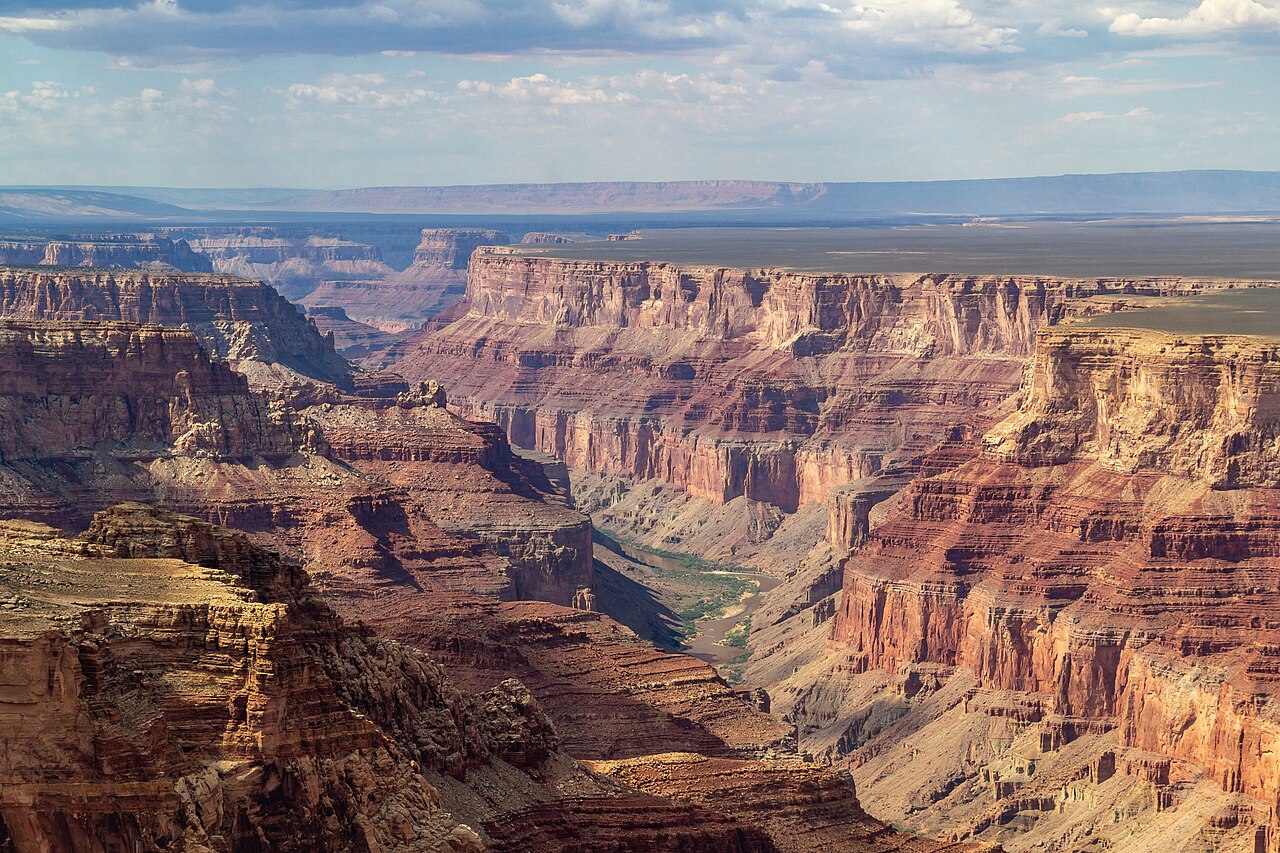
Powell's journey transformed public understanding of the American West and seeded the conservation movement that would follow. His vivid reports, combined with the paintings of Thomas Moran and the photographs of William Bell, brought the canyon into the national imagination at a moment when industrialization was reshaping the landscape everywhere else. Theodore Roosevelt visited in 1903 and famously urged Americans to leave the canyon unimpaired for their children's children, eventually designating it a National Monument in 1908. It became a National Park in 1919, and by the middle of the twentieth century it had become one of the defining symbols of the American idea of wilderness — a place so overwhelming in its beauty that the federal government had committed to preserving it in perpetuity.
The South Rim, accessible year-round and home to the historic Grand Canyon Village, anchors the visitor experience for most of the park's five million annual guests. The village itself carries a distinct architectural legacy: the 1905 El Tovar Hotel, designed in the Arts and Crafts style by Charles Whittlesey for the Fred Harvey Company, still stands as one of the finest historic lodges in the national park system, its dark log-and-stone facade perched a mere few hundred feet from the rim. Nearby, the Kolb Studio, built by brothers Ellsworth and Emery Kolb into the canyon wall in 1904, served for decades as a photography operation and a gathering point for adventurers preparing to descend. The Bright Angel Trail, used by Indigenous peoples for centuries and widened into a tourist route in the early 1890s, remains the most traveled path to the canyon floor, switchbacking past the Indian Garden oasis — now renamed Havasupai Gardens — to Phantom Ranch, the only lodging below the rim, built in 1922 by pioneering architect Mary Colter.

Mary Colter's fingerprints are everywhere at the Grand Canyon, and she deserves particular attention. A self-taught architect hired by the Fred Harvey Company, Colter designed Hopi House, the Lookout Studio, Hermit's Rest, the Watchtower at Desert View, and Phantom Ranch — a body of work that drew deliberately on Indigenous architectural traditions and attempted to make human construction feel as though it belonged to the canyon rather than imposed upon it. Her Watchtower, completed in 1932, incorporates reproductions of ancient Hopi and Ancestral Puebloan murals and was built to evoke the prehistoric towers found at Mesa Verde and Hovenweep. Standing inside it at sunset, watching the canyon walls shift from amber to violet, it is difficult not to feel that Colter understood something essential about how architecture should respond to overwhelming landscape.
Today the Grand Canyon rewards visitors who slow down. The North Rim, open only from mid-May to mid-October due to its higher elevation, offers solitude and a perspective that feels almost foreign compared to the heavily visited South Rim — the canyon viewed from a different angle is genuinely a different canyon. River trips through the inner gorge, ranging from three days to three weeks, deliver an immersion that rim viewing cannot approximate, passing Redwall Cavern, Vasey's Paradise, and the confluence with the Little Colorado where the water runs a strange, luminous blue-green. Whatever the entry point, the canyon has a way of silencing the visitor, not through beauty alone but through the sudden, vertiginous awareness of deep time — of standing at the edge of an Earth that existed long before us and will endure long after.