
Borobudur rises from the green heart of central Java like a dream half-remembered — a colossal stone mountain carved into the shape of the cosmos itself. Built around 800 CE during the reign of the Sailendra dynasty, this Buddhist monument was constructed on a natural volcanic hill above the fertile Kedu Plain, a landscape so productive it was known as the Garden of Java. Covering nearly 2,500 square meters at its base and containing more than two million blocks of andesite fitted together without mortar, Borobudur is not merely the largest Buddhist temple on Earth — it is an entire universe in stone, a pilgrim's map to enlightenment frozen in volcanic rock and still drawing seekers from around the world more than twelve centuries after its completion.
Explore Borobudur
See Borobudur in our curated photo essay.
Think you know Borobudur? Take our 10-question quiz and find out.
The structure is a three-dimensional mandala — a sacred diagram of the Buddhist cosmos — designed to be traversed from base to summit as an act of spiritual ascent. Six rectangular terraces rise from the ground, topped by three circular platforms, each studded with latticed stone stupas cradling seated Buddha figures posed in gestures encoding specific teachings. At the apex stands a single great central stupa, hollow and pointing toward the sky, representing the formless realm of nirvana. Around the lower galleries, four kilometers of bas-relief panels — the longest continuous narrative relief in the world — tell the stories of the Jataka tales, the life of the historical Buddha, and the pilgrim Sudhana's journey toward awakening. Walking these galleries counterclockwise as tradition dictates, visitors encounter 2,672 relief panels and 504 Buddha statues in all. Borobudur is not a building you enter so much as a scripture you walk through.
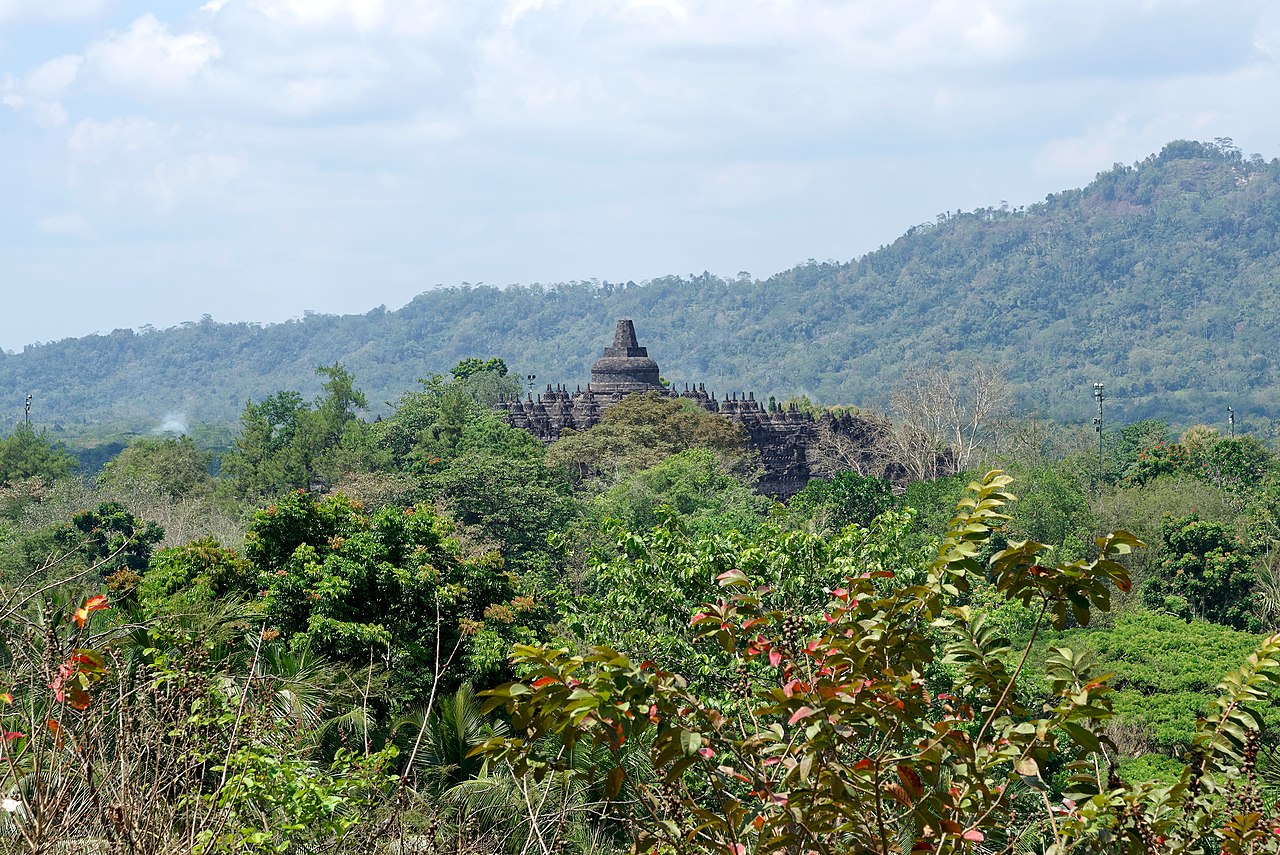
For reasons still debated — volcanic disruption, shifting trade routes, the gradual spread of Islam across the archipelago — Borobudur was abandoned sometime around the 14th or 15th century and slowly reclaimed by the Javanese jungle. For centuries it lay buried under volcanic ash and dense vegetation, known only to local villagers who told stories of a haunted hill. In 1814, Thomas Stamford Raffles, the British Lieutenant-Governor of Java, received word of the mysterious buried monument and dispatched engineers to investigate. Excavation and documentation continued under Dutch colonial authorities through the 19th century, and in the 1970s UNESCO coordinated a massive international restoration effort that disassembled the entire monument stone by stone, treated each block for moisture and biological growth, and reassembled it with forensic care. What visitors see today is the product of that heroic recovery — a civilization's masterwork returned from the dark.
To understand Borobudur is to understand the extraordinary kingdom that built it. The Sailendra rulers presided over a maritime realm deeply integrated into the trade routes linking India, China, and the archipelago, and they were ardent patrons of Mahayana Buddhism at a moment when that faith was flourishing across maritime Southeast Asia. The monument was almost certainly an active pilgrimage destination drawing monks and merchants from across the known world. It stands only 40 kilometers from Prambanan, the great Hindu temple complex built by rival dynasties in the same century — a reminder that 9th-century Java was a place of theological plurality and artistic ambition with few equals anywhere on the planet. Together these monuments represent perhaps the greatest concentration of religious architecture ever raised within a single generation anywhere in human history.

The best way to arrive at Borobudur is before dawn. Sunrise tours bring small groups to the upper terraces in darkness, in time to watch the sun lift above the cone of Mount Merapi and ignite the surrounding plains in gold. In that early light, with mist still pooling in the river valleys below and the great stupas emerging one by one from the dark, the monument achieves something that midday visits can only approximate — a sense of genuine sacred geography, of a place designed to align the human spirit with something larger than itself. The full circuit of the galleries, walking all nine levels from base to summit, takes several hours and rewards close attention. Details that appear merely decorative from a distance resolve into complete narrative scenes: merchants at sea, royal processions, musicians, dancers, animals, and the full texture of 9th-century Javanese life rendered with extraordinary specificity. The site museum at the base and the traditional villages of Borobudur town extend the experience into living culture.
Borobudur is routinely described as one of the great wonders of the ancient world, a designation it carries without exaggeration. Its deeper distinction is what it represents: the ambition of a civilization to render the entire structure of the universe in stone, to build a mountain that was also a book, a temple that was also a map of consciousness. That it was lost for five centuries and then fully recovered makes it something more — proof that the human drive to create things of transcendent beauty is itself indestructible. Whatever brings you to Java, make time for the mountain in the jungle. It will stay with you longer than almost anything else you will ever see.